lkuiumsida.ac.id – Invaluable insights within international student exchange programs often manifest far outside the traditional university lecture halls. This holds remarkably true for Salsa, a dedicated undergraduate student from the English Education Department at Universitas Muhammadiyah Sidoarjo (UMSIDA). Currently participating in an prestigious academic mobility program at the A.K. Kussayinov Eurasian Humanities Institute (EAGI) in Kazakhstan, she has spent the opening ten days of October 2026 exploring the multifaceted dimensions of global education through an array of immersive academic, professional, and socio-cultural activities. By stepping beyond the conventional parameters of her home university, she has managed to transform her short time abroad into a profound learning experience that promises to reshape her future approach to teaching and language acquisition. (30/09).
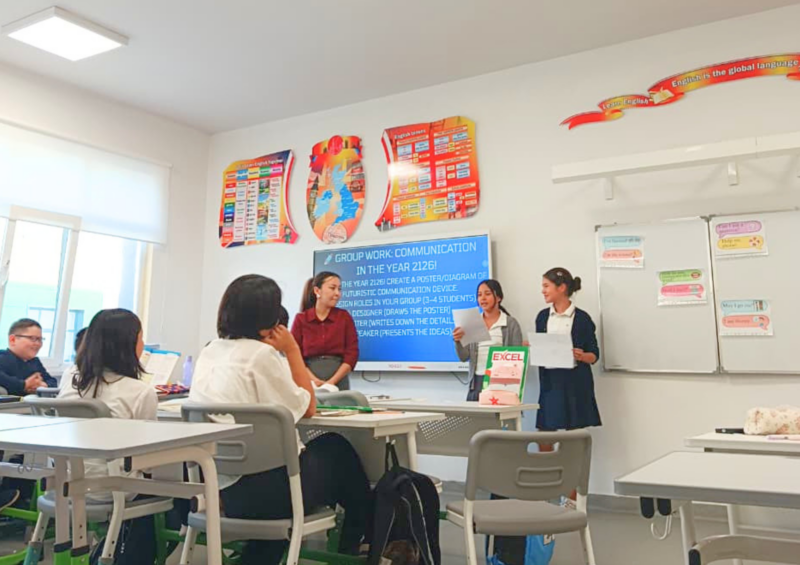
A foundational highlight of Salsa’s institutional itinerary involved an immersive site visit to a local comprehensive school in Kazakhstan. This unique educational institution accommodates a diverse student body spanning from Grade 1 all the way through Grade 12 within a singular, unified school environment. Seeing students at vastly different stages of their physical and cognitive development learning under one roof left a highly powerful impression on the visiting student. During her extensive institutional visit, she was granted the opportunity to observe the pedagogical methods and instructional dynamics within Grade 6 and 7 classrooms, where she paid close attention to how local teachers managed their classrooms and how young learners absorbed complex information.
The highly conducive, vibrant, and well-managed classroom environment immediately caught her attention. Rather than displaying passive behavior, the local students demonstrated an exceptional level of enthusiasm whenever the teacher introduced interactive learning sessions. The moment a lesson shifted into a competitive quiz format, the entire room transformed into a lively intellectual arena. Students eagerly raised their hands, competing with immense energy to answer questions, participate in discussions, and secure precious academic points for their respective teams. “Observing the highly conducive and dynamic atmosphere in the Kazakhstani classroom demonstrated how a well-structured quiz can significantly enhance student engagement,” Salsa observed while closely analyzing the interaction.
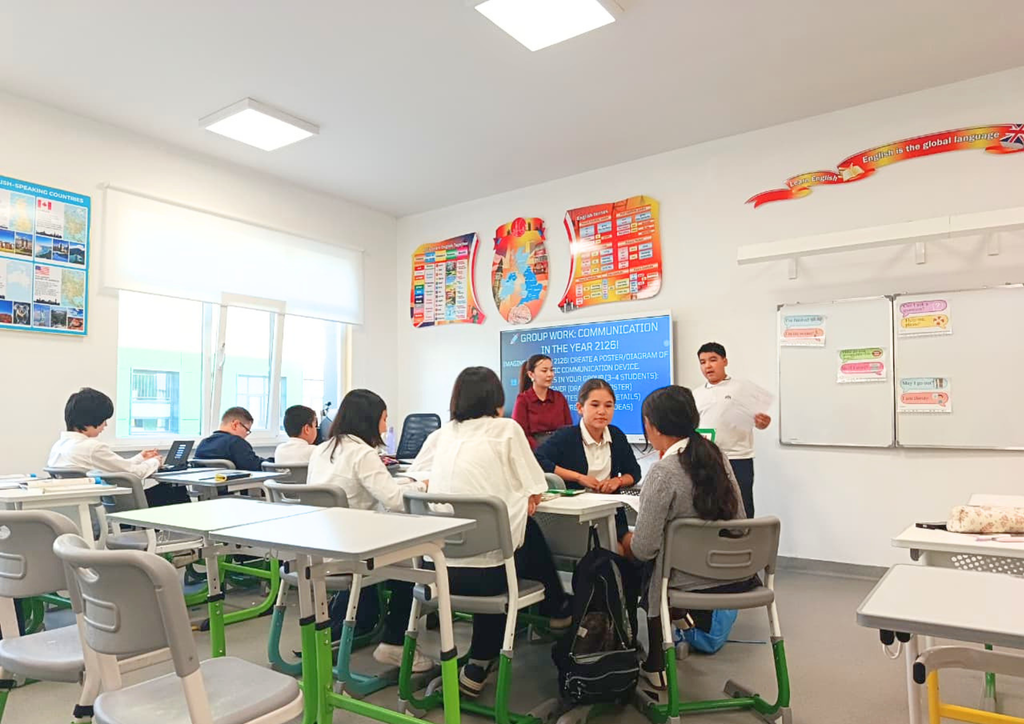
For an English Education major, this particular exposure served as a critical pedagogical reflection on how foundational classroom activities can stimulate learner participation and transform routine lessons into memorable experiences. She noted that the palpable excitement of the children made the entire learning process feel incredibly lively and engaging. This fascinating interaction has inspired her to design innovative teaching methodologies that effectively foster student motivation in her future career, reinforcing her belief that excellent education is not merely about what teachers explain, but fundamentally about how actively students respond.
Also read: Inside a UMSIDA Student’s Academic Mobility Experience in Astana
Although her primary academic specialization and career focus center on English pedagogy, Salsa capitalized on EAGI’s diverse curriculum to pursue Chinese as a second foreign language during her exchange program. Diving into an entirely new linguistic system presented an array of unfamiliar vocabularies, highly intricate tonal systems, and complex syntactic frameworks that differed drastically from both her native Indonesian and her professional language, English. Rather than viewing these linguistic variations as daunting obstacles, she chose to approach the challenge with deep curiosity and structured patience. She further explained, “Studying Chinese as a second foreign language at EAGI has fundamentally shifted my perspective on linguistics, proving that language acquisition is less about rote memorization and more about navigating unfamiliar communicative structures with patience and cultural curiosity.”
This academic pursuit did not merely diversify her theoretical knowledge; it substantially deepened her overall cross-cultural competence. She realized that truly mastering a foreign tongue requires individuals to become fully familiar with an entirely different cognitive system, gradually building the necessary confidence to express thoughts accurately. For Salsa, studying Chinese alongside English has made her academic journey at EAGI immensely rich and multi-dimensional, allowing her to appreciate language learning not just as an isolated academic subject, but as a vital bridge to understanding diverse global cultures and forms of human communication.
Beyond structured classroom instruction and rigorous language modules, Salsa actively integrated into local student life by participating in dynamic extracurricular initiatives, notably the institutional Speaking Club. For an English Education student, having access to regular spaces where communication is practiced outside formal evaluation is immensely valuable. It allows language learning to move from textbook theories into the realm of practical, real-world application. Through these interactive sessions, she learned to navigate the unpredictable nature of cross-cultural communication, discovering how to connect with peers who come from entirely different linguistic backgrounds.
Also read: From Exhibition to Exploration: Zelfa’s Journey in Bueng Kan, Thailand
Complementing her intense academic track, she maintained her personal well-being and physical health by regularly engaging in light recreational exercises, including running and playing volleyball with her newly formed circle of friends. These moments provided a vital balance to her studies, showing that life as an exchange student involves managing academic obligations while nurturing social bonds. Playing volleyball, in particular, created unique opportunities for genuine human connection that did not depend entirely on verbal fluency. Sharing a physical sport allowed students to cooperate, build mutual trust, and enjoy each other’s company without the pressure of formal language structures.
“Engaging in the campus Speaking Club and participating in recreational sports like volleyball provided vital spaces for organic, non-formal communication,” noted her. She maintained that these interactions are absolutely crucial for bridging persistent language barriers and building practical pedagogical adaptability. Rather than viewing the inevitable challenges of communicating across cultural divides as frustrating barriers, she has gracefully reframed them as unique opportunities to become a more patient, resilient, and highly adaptable individual. These practical experiences are incredibly relevant to her future career as an educator, serving as a powerful reminder that powerful learning environments can easily extend far beyond the margins of textbooks and formal lecture halls.
Reflecting deeply on her immersive experiences throughout the early period of this exchange, Salsa concluded that the true essence of an international academic exchange lies in holistic, continuous learning that transcends standard university coursework. The school visit forced her to reconsider the vital importance of student participation and the role that engaging classroom designs play in primary education. Simultaneously, her encounters with the Chinese language introduced her to a fresh language-acquisition perspective, while campus recreational activities allowed her to form deep, lasting bonds with peers outside formal academic discourse.
Salsa concluded, “My initial ten days in Kazakhstan have reinforced the idea that becoming an effective educator requires one to remain a lifelong, curious learner who continually seeks insights from diverse and unfamiliar educational environments.” This international academic mobility milestone at the Eurasian Humanities Institute (EAGI) is highly anticipated to yield ongoing educational insights, robustly supporting both her current undergraduate development at UMSIDA and her prospective trajectory as an adaptive English educator. Her journey serves as a brilliant testament to the fact that becoming an outstanding teacher begins with an unwavering willingness to observe, explore, and learn from the world outside the familiar classroom.
Source: Salsa BillaNazin Zahir