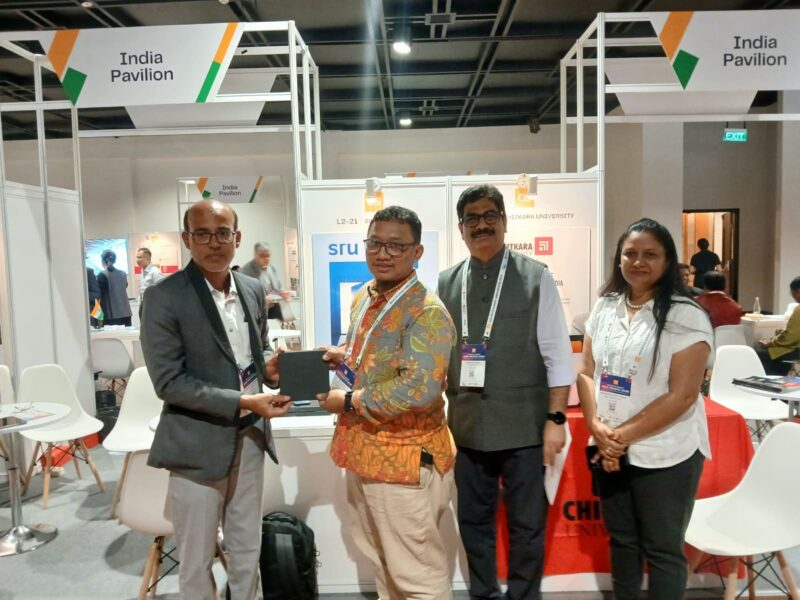
lkui.umsida.ac.id — For UMSIDA, the QS Higher Ed Summit Asia Pacific 2026 has yielded more than insight; it has produced a concrete outcome (05/11). On the sidelines of the summit, Universitas Muhammadiyah Sidoarjo (UMSIDA) signed a Memorandum of Understanding (MoU) with SR University, India, marking a new chapter in the university’s international cooperation.

The MoU was signed by Niko Fediyanto, Director of Language, Cooperation, and International Affairs (DBKUI), representing UMSIDA. For an institution that has, until now, built most of its international ties with partners in Southeast Asia, the agreement with an Indian university is significant. It opens a corridor that has remained relatively unexplored—one that could bring UMSIDA closer to India’s rapidly expanding higher education landscape, known for its strengths in engineering, technology, and research.
“Until now, most of UMSIDA’s international partners have come from ASEAN. We are currently developing cooperation with several partners from Eurasia and West Asia,” Fediyanto said, underscoring that the partnership with SR University is part of a deliberate geographic expansion rather than an isolated initiative. He added that broadening cooperation across regions would strengthen the university: “The geographic expansion of cooperation will certainly make UMSIDA better, as it will be able to gain knowledge from diverse cultural perspectives.”
The choice of SR University is worth noting. As a private university in India with a growing profile in research and innovation, it offers a potential complement to UMSIDA’s own academic ambitions. While the specific scope of the cooperation is still to be detailed, the MoU lays the foundation for collaboration in areas such as student and faculty exchange, joint research, and academic capacity building.
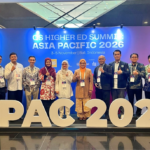
The signing took place in the margins of the summit, alongside UMSIDA’s participation together with more than a dozen other Perguruan Tinggi Muhammadiyah ‘Aisyiyah (PTMA) institutions, all of which share the goal of elevating Muhammadiyah higher education internationally. For UMSIDA, this new partnership reinforces its broader strategy: building a regional reputation within ASEAN while gradually expanding its global network.
For a university still writing its international story, the MoU with SR University is a meaningful step. It signals that UMSIDA is not only present at global forums, but is translating visibility into tangible cooperation—and that India, a country with which it has had little prior academic engagement, may now become part of its expanding global map.
Source: Niko Fediyanto