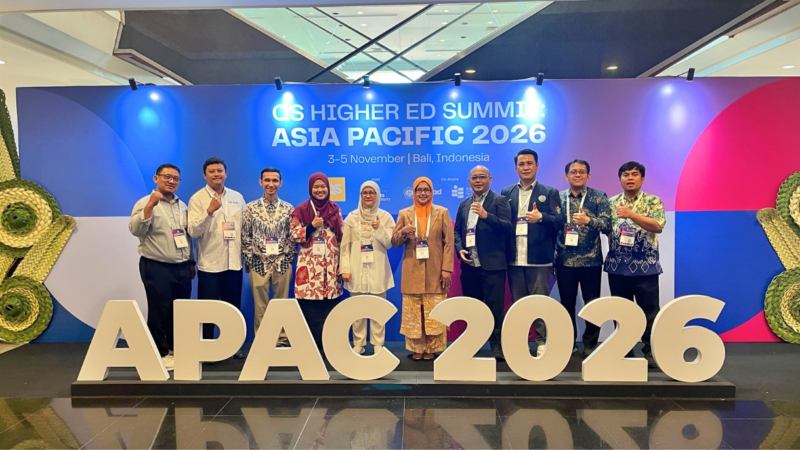
lkuiumsida.ac.id — Amid the hundreds of rectors and senior university leaders from across Asia Pacific who crowded the Bali International Convention Centre, the name Universitas Muhammadiyah Sidoarjo (UMSIDA) may not yet have been the centre of attention. Yet behind the bustle of the QS Higher Ed Summit: Asia Pacific 2026, UMSIDA’s move carried a clear ambition: to secure ASEAN recognition, not merely to record its presence at an international forum. (5/11).
UMSIDA’s participation in the prestigious event, held from 3 to 5 November, was represented by Niko Fediyanto, Director of Language, Cooperation, and International Affairs (DBKUI). His presence was far from incidental. Amid discussions on internationalisation strategies, global rankings, and cross-border partnerships, Niko brought a more specific agenda: to ensure that UMSIDA is not merely a passive participant, but part of the conversation about the future of higher education in the region.
“UMSIDA is committed to elevating itself to the international level. Naturally, we must seek references on the direction of future development,” Fediyanto said, emphasising that the summit served as a strategic learning ground for the university’s internationalisation agenda.
What makes UMSIDA’s presence particularly noteworthy is its context. The university did not come alone. UMSIDA attended alongside more than a dozen other Perguruan Tinggi Muhammadiyah ‘Aisyiyah (PTMA) institutions, all of which are equally committed to elevating Muhammadiyah higher education onto the international stage. This collaboration forms part of a collective strategy coordinated by the Muhammadiyah Council for Higher Education, Research, and Development (Diktilitbang), with the objective of strengthening PTMA institutions in the global higher education landscape—not as spectators, but as players.
For UMSIDA, the forum served as an opportunity to test the seriousness of the efforts it has been building behind the scenes. In recent months, the university has demonstrated concrete steps towards internationalisation, including its involvement in a specialised workshop on international ranking methodologies, in which a cross-functional team examined the criteria used by QS and Times Higher Education in depth. This move indicates that UMSIDA recognises that global reputation is not built through rhetoric, but through systematic improvements in research output, international faculty ratios, and overall academic quality.
Nevertheless, UMSIDA’s ambition must be viewed with a clear eye. The target of ASEAN recognition is by no means a simple matter. Competition among higher education institutions in the region is intensifying, with universities in Malaysia, Thailand, the Philippines, and Singapore having established themselves earlier across various regional rankings. As a relatively young university based in a regency, UMSIDA faces structural challenges: limited resources, an international network that is not yet fully mature, and visibility that still needs to be built.
It is precisely here that the sharpness of UMSIDA’s strategy lies. By setting ASEAN recognition as its milestone, the university has chosen a path that is more realistic and measurable than immediately pursuing a position among global ranks. ASEAN recognition allows UMSIDA to build its reputation incrementally, starting from the nearest region before venturing further afield.
Also read: Thai National Language Day Celebration at Wichitwittaya School
The summit itself was attended by more than a thousand delegates from various countries across Asia Pacific, making it one of the most influential higher education forums in the region. It was here that UMSIDA had the opportunity to build networks, learn from best practices, and introduce itself to prospective strategic partners—every conversation and insight contributing to the accumulation of regional reputational capital.
When the summit concluded and the delegation returned to Sidoarjo, UMSIDA did not come home with a trophy or a headline-grabbing leap in the rankings. Yet what it brought back was no less valuable: a sharper understanding of the regional higher education landscape, connections that have begun to take shape, and an increasingly clear sense of direction. The road to ASEAN recognition is not a sprint, but a marathon that demands consistency, collaboration, and a commitment to quality.
UMSIDA’s presence at the QS Higher Ed Summit Asia Pacific 2026 is a signal that the university is no longer content to remain a spectator on the sidelines. UMSIDA is stepping onto the field, aligning its strategy with the broader Muhammadiyah movement, and asserting its intention to become a player to be reckoned with in the region’s academic future.
Source: Niko Fediyanto