lkui.umsida.ac.id – The term “touching grass” first emerged and gained popularity on the social media platform X (formerly Twitter) in 2015. Contextually, this expression was initially used as a form of persuasive satire directed at individuals who spent excessive time indoors, such as those with device addiction or those isolating themselves from social interactions. Literally, the term signifies an invitation to reintegrate with the physical natural world. However, in its development, the essence of this originally sarcastic term was successfully transformed into a concrete ecological action by Abimael, a student directly involved in an environmental initiative in Thailand. (29/07)
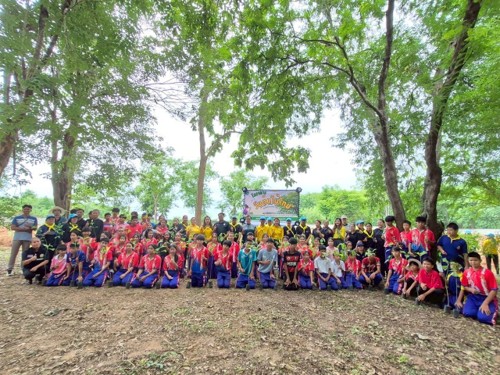
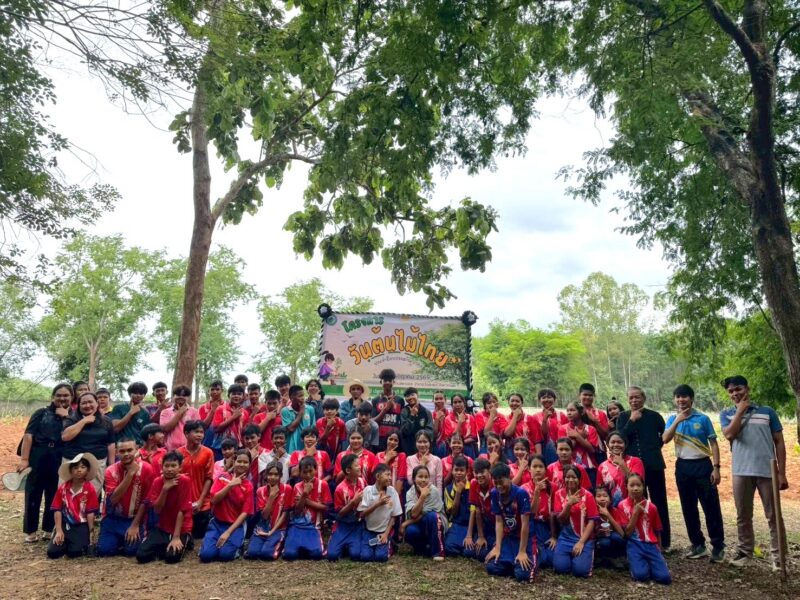
This environmental conservation action was carried out at Srisuwanwanaram Temple, an area integrated within an educational institution’s environment. The activity was based on meticulous planning, with implementation details coordinated by the mentor teacher, Teacher Oui, one day prior to the event. Teacher Oui conveyed that “On Friday, a joint tree-planting action will be held with students from classes Master 1 to 3, which will be carried out in the morning.” Although Teacher Oui was unable to attend on the day of implementation, the activity was successfully realized in a structured manner under the supervision and guidance of six fellow teachers. The planting location was highly strategic, requiring a travel time of only three to four minutes from the school.
The series of activities commenced with a comprehensive educational seminar regarding effective silviculture (tree cultivation) techniques and an analysis of their ecological benefits for environmental sustainability. Language barriers in material delivery were overcome through translation facilitation provided by an educator from Wangtaen School, Teacher Yon. The seminar proceeded smoothly and accommodatively, with beverage facilities provided for participants. Through this presentation, empirical data was obtained indicating that the majority of Thailand’s landmass and islands possess a high level of vegetation cover. This indicates that tree planting is no longer merely a cultural activity, but rather reflects the ecological awareness of the Thai community toward nature conservation.
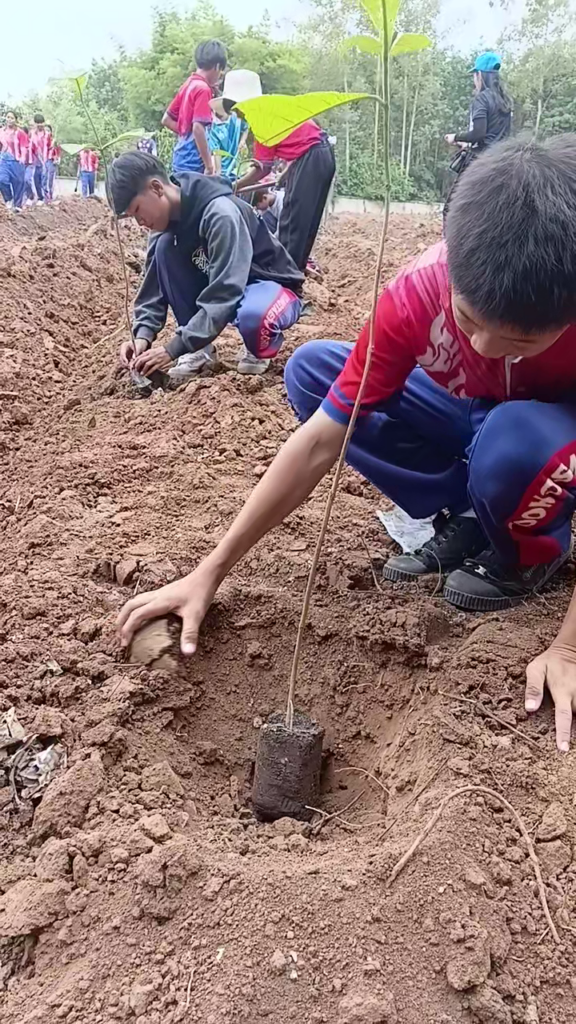
Post-seminar, the core activity was implemented on a fairly extensive plot of open land. Various tree seedling varieties were planted collectively through active collaboration among teachers, students, and representatives from Wangtaen School. The spirit of mutual cooperation (community engagement) fostered during this implementation became a crucial determinant in ensuring the long-term sustainability of the conservation program. For the participating student, this activity provided valuable empirical experience, as the adaptation process continued despite lacking a prior background in agronomy. Through direct technical guidance from local teachers and students, basic techniques such as soil excavation, seedling handling, and the proper utilization of cutting tools were mastered, even though a minor finger injury occurred.
Operational challenges arose when heavy rain drenched the location midway through the activity, temporarily dampening the participants’ optimism. However, this momentum was successfully overcome through motivational reinforcement delivered by an educator from Wangtaen School, Teacher Jakhapan. Teacher Jakhapan delivered a message that prompted all participants to reflect, emphasizing that anyone who wished to stop was welcome to do so, but reminding everyone to think about the consequences of that decision. This philosophical reflection successfully reconstructed the participants’ commitment to complete the planting program under those weather conditions.
In general, the reflections from this activity yielded several strategic learning points. First, regarding the technical aspect, the importance of implementing occupational safety procedures when utilizing sharp tools. Second, from a sociocultural perspective, tree planting in Thailand has become deeply rooted as a noble tradition passed down through generations. The success of this consistent ecological policy is evidenced by the lush green open spaces in city corners and transport routes across Thailand.
This comparative experience is expected to be adopted and implemented in Indonesia as a preventive solution to rampant, uncontrolled deforestation and forest exploitation across various regions of the homeland. Furthermore, a massive tree-planting culture carries high urgency for Indonesia, particularly in mitigating air pollution in urban areas and improving the air pollution standard index. Therefore, internalizing the culture of planting and nurturing trees not only holds educational value, but also serves as a strategic pillar of action that must be continuously accelerated for global ecosystem balance.
Source: M. Abimael Samlin